


How predictive models boost opportunities, win rates, deal size and shorten sales cycles to accelerate revenue.
Predictive models are transforming how sales teams work by identifying high-converting opportunities, improving win rates, and shortening sales cycles. Instead of relying on outdated data or gut instincts, these models analyze historical and real-time insights to prioritize leads and flag risks before deals stall. The result? Faster revenue generation and more efficient sales processes.
Here’s the formula for sales velocity:
(Opportunities × Deal Size × Win Rate) ÷ Sales Cycle Length.
Predictive tools improve each component:
Opportunities: Focus on high-fit leads using AI-driven scoring.
Win Rate: Spot at-risk deals early and focus on high-probability leads.
Deal Size: Pinpoint upsell and cross-sell chances.
Sales Cycle: Automate tasks to reduce delays.
With predictive models, companies report up to 43% better forecast accuracy and 10–15% higher sales efficiency. But success depends on clean, recent data and aligning predictions with actionable sales strategies. Tools like K3X even automate follow-ups and lead routing, ensuring insights turn into results.
The takeaway? Predictive models help sales teams focus on what matters most, driving quicker conversions and higher revenue.
Sales Velocity and Its Core Drivers
What Is Sales Velocity?
Sales velocity measures how quickly your sales pipeline converts opportunities into revenue. It’s typically expressed as a daily or monthly revenue rate. Ben Kazinik, Senior SEO Manager at monday.com, explains it well:
"Sales velocity solves this problem by combining four essential factors into a single metric that reveals your true revenue generation speed." [9]
The formula to calculate sales velocity is: (Number of Opportunities × Average Deal Size × Win Rate) ÷ Sales Cycle Length. Each variable plays a crucial role. For example, increasing your win rate from 20% to 25% can result in a 25% boost in overall sales velocity. The same principle applies to every component - improving any factor can accelerate your revenue growth.
Predictive models take this concept further by enhancing these components, helping businesses generate revenue more efficiently.
How Predictive Models Affect Core Sales Metrics
Predictive models can amplify opportunity volume, increase win rates, grow deal sizes, and shorten sales cycles - all of which contribute to a faster sales velocity.
Opportunity Volume: AI-driven Ideal Customer Profile (ICP) analysis helps filter out low-potential prospects before they even reach your sales team. Instead of spreading efforts thin, teams can zero in on high-fit accounts that resemble their best customers. Advanced lead scoring can generate 50% more sales-ready leads while lowering the cost per lead by 33% [2].
Win Rate: Predictive models use real-time signals to monitor deal health and engagement, flagging at-risk deals before they stall. By focusing on the top 20% of leads - those responsible for around 80% of conversions - teams can raise win rates in this segment from a baseline of 5% to 25%[2].
Deal Size: By analyzing buying patterns, predictive insights can identify upsell and cross-sell opportunities, suggesting the next-best actions tailored to each account’s behavior.
Sales Cycle Length: AI-native automation streamlines lead routing and eliminates time-consuming administrative tasks, reducing delays caused by manual handoffs and process bottlenecks.
Velocity Component | How Predictive Models Help |
|---|---|
Opportunities | Prioritizes leads based on fit and likelihood to convert [3] |
Win Rate | Identifies at-risk deals early using engagement and sentiment data [3] [4] |
Deal Size | Highlights upsell and cross-sell opportunities using purchasing trends [3] |
Sales Cycle | Automates processes to minimize delays and friction [3] |
Data Inputs That Power Predictive Models
Key Data Categories for Predictive Modeling
The success of a predictive model hinges on the quality and variety of the data it uses. While most teams start with basic CRM data - like deal stage history, close dates, and contact records - this is just the beginning. Adding additional layers of data can provide much-needed context and improve accuracy.
CRM lifecycle data, combined with buyer engagement metrics, helps clarify where a deal stands and how a prospect is behaving. Conversation signals, such as objections raised or mentions of pricing, give insight into the dynamics of ongoing deals. Intent signals, like visits to pricing pages or platforms like G2, reveal when prospects are actively researching. External signals, such as new leadership hires or changes in a company's tech stack, can highlight buying opportunities that might otherwise go unnoticed. One particularly strong indicator is the "colleague signal", which shows that a lead is 3–5 times more likely to convert if someone else at their company has already made a purchase [2].
It’s equally important to include negative signals, like email unsubscribes, missed meetings, or prospects going silent after discussing pricing. These indicators help prevent inflated scores and ensure the model's predictions remain trustworthy.
Data Category | Examples | Why It Matters |
|---|---|---|
CRM Lifecycle | Stage history, close dates, deal amount | Establishes the structural foundation for accurate forecasting [2] |
Buyer Engagement | Email response times, meeting frequency | Tracks active engagement from prospects [10] |
Conversation Signals | Objections, pricing mentions, sentiment | Provides detailed insights into deal dynamics [7] |
Intent Signals | Pricing page views, G2 visits | Shows when prospects are actively researching their options [1] |
External Signals | Job postings, tech stack changes | Identifies buying opportunities tied to growth or restructuring events [5] |
These data layers combine to create a well-rounded foundation for precise and actionable predictive scoring.
Why Data Completeness and Recency Matter
Even with the right data categories, the quality and timeliness of the data are critical. Predictive models, no matter how advanced, will fail if they rely on incomplete or outdated information. As predictive sales expert Ilan Asseo explains:
"A simpler model with strong data discipline is usually more valuable than a complex model nobody trusts." [7]
Low-quality data can severely damage a model's accuracy. For instance, 47% of new CRM records contain at least one critical error [11], and these mistakes cost organizations an average of $12.9 million annually [11]. Missing contact roles, poorly defined deal stages, and inconsistent field values don’t just cause reporting issues - they directly harm the training data that powers your model.
Timeliness is just as crucial as completeness. For example, intent signals like a recent pricing page visit lose their value if not captured quickly. A lead with three recent high-intent signals, such as visiting a pricing page yesterday, is far more valuable than one with 30 low-intent signals spread out over the past year [2]. To address this, modern predictive tools often use decay-based weighting, which prioritizes recent actions. These tools typically apply a half-life of 14–30 days to ensure the focus stays on current prospect activity.
How to Build and Apply Predictive Scoring Models
Steps to Build a Predictive Scoring Model
Creating a predictive scoring model can be simple if you follow a structured approach. Skipping foundational steps, however, can erode your team's confidence in the results.
The first step is defining your goal. Be specific about what you want to predict, such as "becomes a SQL within 14 days" or "closes by the end of the quarter" [7]. Vague objectives lead to unreliable models. Once you’ve nailed down the target, gather 12 months of historical deal data, clearly labeled with wins and losses. This helps you identify patterns that are strong and reliable [13].
Next comes feature engineering - transforming raw CRM data into useful insights. For instance, instead of just noting whether someone "visited the pricing page", create a more detailed signal like "visited pricing page more than 3 times in 7 days" [7][13]. Be cautious of label leakage, which happens when you include data that wouldn’t be available at the time of prediction (e.g., meeting notes when predicting booked meetings). This can make your model seem more accurate than it really is [7].
Before fully rolling out your model, run it in parallel for about four weeks. This “shadow forecasting” phase allows you to compare predictions with actual outcomes, build trust, and fine-tune decision thresholds [4]. Once the model is live, plan to retrain it quarterly to keep up with changes in buyer behavior and product updates [7][13].
If you’re just starting, a logistic regression model using 20–30 key features is a great starting point. It’s easier to explain to your sales team and adjust as needed compared to more complex methods like gradient-boosted trees [7][12]. Aim for at least 70% accuracy on binary predictions before deploying the model in real-world scenarios [13].
When the model is ready and validated, the next step is to connect scores to actionable sales strategies.
Using Predictive Scores to Prioritize Sales Opportunities
A predictive score is only useful if it drives action.
"A score without a decision rule becomes shelfware." - Kakiyo [7]
Once your model is validated, the real value comes from translating scores into specific sales actions. A clear framework might look like this [12]:
Score Range | Action |
|---|---|
80–100 | Immediate AE outreach and priority booking |
60–79 | SDR multi-channel sequence with a 48-hour SLA |
40–59 | Marketing nurture tracks |
Below 40 | Automation only |
Scores can also highlight warning signs, such as declining engagement or deals stuck in a stage too long, prompting managers to step in at the right time [4][8]. For example, companies with effective predictive scoring have reported a 40% reduction in sales cycle length for accounts scoring 70 or higher. Additionally, win rates for top-scored accounts are often three times higher than for lower-scored ones [12].
In B2B sales, predictive scoring tends to work better at the account level rather than for individual leads. By aggregating activity across the entire buying committee, you get a much clearer picture of how ready an account is to make a purchase [1][12].
"The best teams treat predictive scores as inputs to judgment, not replacements for it." - Fluum [5]
How To Use The Four Sales Velocity Levers To Hit Your Targets
Measuring the Impact of Predictive Models on Sales Velocity
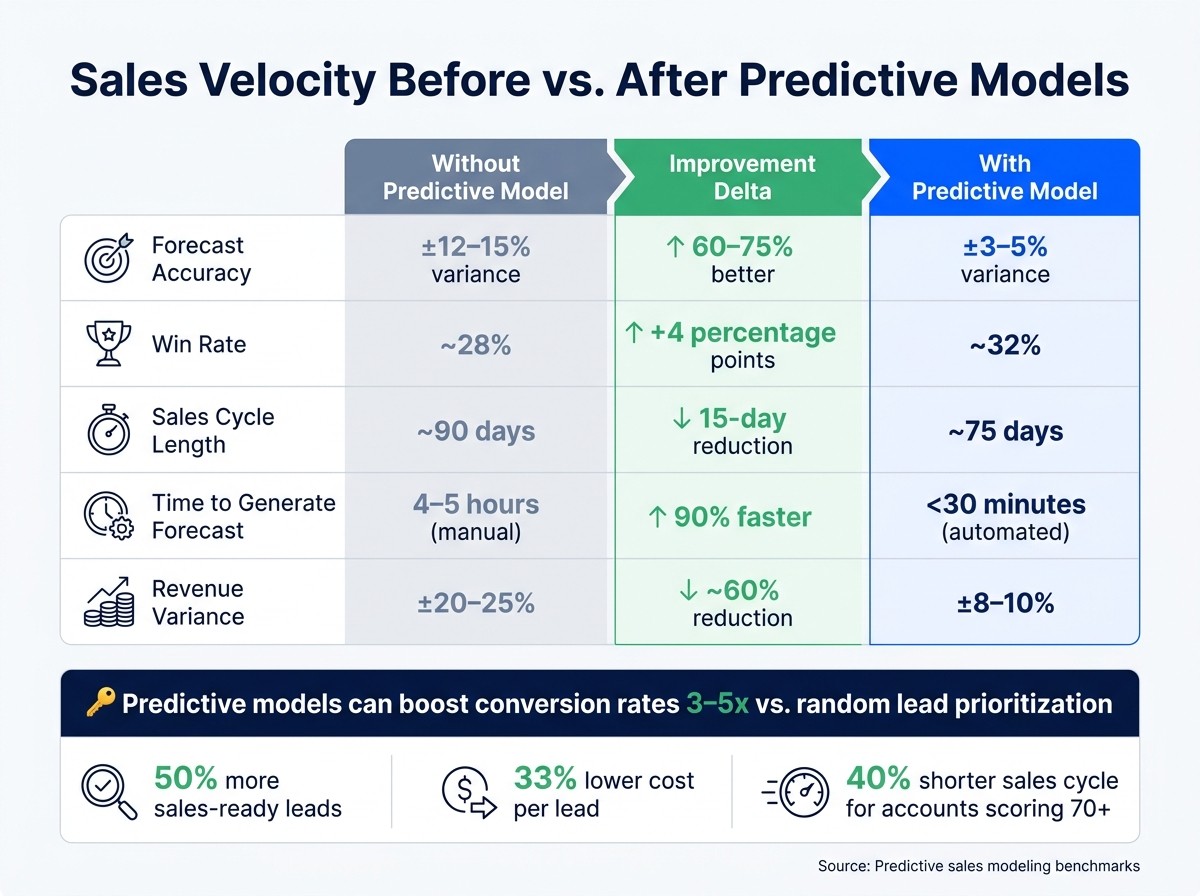
Sales Velocity Before vs. After Predictive Models: Key Metrics Compared
Key Metrics to Track
Once your predictive model goes live, it's essential to monitor specific metrics to gauge its effectiveness. The four core inputs of sales velocity - opportunities, average deal size, win rate, and cycle length - are a great starting point [3]. These metrics collectively help pinpoint which part of the sales process your model is improving.
In addition to these, two other metrics can provide deeper insights. First, the pipeline progression rate, which measures how quickly deals move through stages, helps determine if your model is guiding reps toward deals with real potential. Second, forecast accuracy is critical. Only 7% of companies achieve a forecast accuracy of 90% or more without machine learning [6], so any improvement here is a clear sign your model is making a difference.
"Predictive sales forecasting has become a true competitive advantage for revenue leaders who need reliable forecasts, not optimistic guesses." - Alex Zlotko, CEO, Forecastio [6]
Another metric to watch is slipped deals - opportunities delayed beyond the forecast period. A high slippage rate might indicate that your model is missing important qualification signals, suggesting the need for enhanced qualification features [6].
By tracking these metrics, you can effectively measure the model's impact and identify areas for refinement.
Before-and-After: Sales Velocity Metrics Compared
To truly understand the model's influence, start by documenting baseline metrics before deployment. Then, compare these figures after a 90-day pilot. You can also test the model on historical data, such as the previous year’s closed/won and closed/lost deals, to see how it would have performed - this can help build confidence among your team prior to a full rollout [5][14].
The table below highlights typical improvements seen after implementing a predictive model:
Metric | Without Predictive Model | With Predictive Model | Improvement |
|---|---|---|---|
Forecast Accuracy | ±12–15% variance | ±3–5% variance | 60–75% better [14] |
Win Rate | ~28% | ~32% | +4 percentage points [14] |
Sales Cycle Length | ~90 days | ~75 days | 15-day reduction [14] |
Time to Generate Forecast | 4–5 hours (manual) | <30 minutes (automated) | 90% faster [14] |
Revenue Variance | ±20–25% | ±8–10% | ~60% reduction [14] |
These improvements can have a compounding effect. For example, a shorter sales cycle paired with a higher win rate doesn’t just improve efficiency - it also accelerates revenue flow through your pipeline. Predictive models can even boost conversion rates by 3–5 times compared to random lead prioritization [2], maximizing the productivity of your sales team without increasing headcount.
Putting Predictive Models to Work with K3X

How K3X Automates Predictive Targeting
K3X takes predictive models and turns them into actionable strategies. While predictive models can deliver powerful insights, their full potential often goes untapped without immediate follow-through. That’s where K3X steps in.
This AI-native CRM isn’t about logging activities; it’s about achieving outcomes. Instead of manually updating pipelines or assigning tasks, you simply state your objective - like, “Route these qualified leads to Alice” - and K3X handles the rest. It evaluates intent, applies routing rules, and automates outreach seamlessly.
What sets K3X apart is its ability to adapt in real time. It tracks lead behavior and adjusts actions on the fly, ensuring no high-priority lead slips through the cracks due to missed follow-ups or system errors. So far, K3X has saved users over 312,000 hours of work and cut operational costs by an estimated $12.4 million [15].
"Most CRMs record activity. K3X understands outcomes. It listens, knows what changed, and makes the next moves." - Mykyta Samusiev, Co-Founder & CEO, K3X [15]
Here’s a real-world example: In December 2025, Ruby Capital Group, a 125-person funding company, implemented K3X in just two days. The results? A 70% reduction in time spent on follow-ups and a threefold increase in ticket resolution speed. CEO Michael Chkechkov highlighted the transformation: “Our sales team was spending half their day on admin work. Now they’re talking to customers and closing deals. The automation handles everything from lead qualification to contract routing.” This level of efficiency is only possible when predictive insights are tied directly to automated actions.
Up next, we’ll explore how K3X outperforms traditional CRMs by seamlessly converting predictive insights into immediate results.
K3X vs. Workflow-Driven CRMs: A Direct Comparison
Traditional CRMs rely on rigid workflows, which often falter when leads deviate from the expected path. Whether it’s a lead asking an off-topic question, skipping a step, or going silent, these systems frequently require manual fixes. Setting up these workflows can take weeks and often involves third-party tools like Zapier or Make. Plus, as processes evolve, constant maintenance becomes a necessity.
K3X flips this approach on its head. Teams can get started in under an hour by connecting their tools and defining goals using simple, natural language prompts - no complex flowcharts, coding, or external automation tools needed.
Here’s how the two compare:
Feature | Traditional Workflow CRMs | K3X AI-Native CRM |
|---|---|---|
Setup Method | Complex flowcharts and manual rule-building processes | Natural language prompts; live in under an hour |
Logic Type | Linear, fixed sequences | Goal-focused, outcome-based |
Adaptability | Breaks if a lead acts unexpectedly | Adapts to replies and behavior in real time |
Data Entry | Manual (up to 20+ hours/week) | Automated and self-filling |
Integrations | Often requires third-party apps | Native, out-of-the-box functionality |
For teams using predictive models, these differences matter. Imagine your model flags a top-priority lead at 9:00 a.m., but your CRM requires manual input to act on it. By the time action is taken, it could be too late. K3X eliminates this lag, instantly turning predictive insights into coordinated actions - no manual handoffs required.
Common Challenges in Predictive Modeling and How to Fix Them
Data Gaps That Reduce Model Accuracy
Even the best predictive models can falter when the data they rely on is incomplete or messy. Problems like missing close dates, outdated deal stages, and duplicate accounts in CRM systems don't just slow down processes - they can mislead the model entirely. These data gaps can skew the training process, leading to inaccurate predictions.
Then there are the less obvious culprits: label leakage and selection bias. Label leakage happens when a model is trained using information that wouldn't be available at the time of prediction. For instance, using "number of meetings held" to predict whether a meeting will be booked creates a flawed model. Selection bias, on the other hand, occurs when training data is limited to leads that sales reps have chosen to pursue, inadvertently teaching the model to mimic rep behavior rather than focusing on actual buyer intent [7].
"A CRM saturated with data is only valuable if it provides clear, actionable foresight rather than retrospective guesswork." - FindMyCRM [16]
Automation offers a way to tackle these issues. AI tools can automatically log meeting notes, call summaries, and email activity into the CRM, reducing the chances of human error. Before deploying a predictive model, it's essential to audit at least 12 months of historical data to identify and address blank fields, inconsistent stage labels, and duplicate entries [17]. Incorporating time-decay logic into your model can also help by giving more weight to recent behaviors - like a prospect visiting the pricing page yesterday - over older interactions [2].
By addressing these data challenges, you'll create a solid foundation for embedding predictive insights into your sales process.
Aligning Predictive Models with Your Sales Process
Fixing data gaps is just the first step. To make predictive models truly effective, they need to align seamlessly with your sales workflow.
A predictive score that no one uses is meaningless. The biggest reason predictive models fail isn't poor accuracy - it’s a lack of integration with the sales team's day-to-day activities [7].
"A useful rule: if it does not change a decision (routing, prioritization, outreach, or staffing), it is not predictive sales AI, it is just analytics." - Ilan Asseo, Kakiyo [7]
To bridge this gap, tie predictive scores directly to specific actions. For example:
High scores might trigger immediate follow-ups or routing to senior reps.
Mid-range scores could signal the need for nurturing campaigns.
Low scores might indicate disqualification.
Context is also key. A score of "87" means little on its own, but it becomes actionable when paired with insights like "visited the pricing page 3 times this week." Providing this level of transparency - often referred to as model explainability - helps build trust and encourages adoption [1][5].
Before fully rolling out a predictive model, run it in shadow mode alongside your existing process. This approach lets you identify any gaps and build confidence in the model without disrupting current workflows [17][11]. By doing so, you ensure that predictive insights translate into real, actionable improvements.
Conclusion: Using Predictive Models to Improve Sales Velocity
Predictive models succeed because they replace guesswork with data-driven insights. Instead of relying on gut feelings to decide which leads to pursue, these models highlight the accounts most likely to close while flagging those that are losing momentum. This shift allows sales teams to focus their energy on opportunities that truly matter, cutting down on wasted efforts.
The stats tell the story. Sales reps currently spend about 60% of their time on leads that never convert [2]. Predictive models tackle this inefficiency by zeroing in on the top 20% of leads responsible for 80% of conversions [2]. Companies using advanced scoring systems see a 50% increase in sales-ready leads while reducing cost per lead by 33% [2]. And the beauty of these models is that they improve over time, continuously fine-tuning their predictions.
But here’s the catch: a score sitting idle in a dashboard does nothing on its own. As Ilan Asseo put it: "If it does not change a decision (routing, prioritization, outreach, or staffing), it is not predictive sales AI, it is just analytics." [7] The real value lies in how well the model influences daily decisions.
This is where K3X bridges the gap. Instead of relying on manual actions or complex automations, K3X uses predictive signals as live inputs to drive execution. It automates lead routing, follow-ups, and pipeline updates in real time. In short, the model doesn’t just provide insights - it takes action.
"The edge comes when analytics move from dashboards to daily decisions." - Salesforce [18]
The steps to get there are clear: clean your data, design models that align with your sales process, and integrate them with a CRM that seamlessly turns scores into action. When these pieces come together, sales velocity transforms from a metric into something you can actively control.
FAQs
What data do I need to make predictive scoring accurate?
To achieve precise predictive scoring, you need high-quality data. This includes engagement signals like website visits and email opens, as well as demographic and firmographic details such as industry type and company size. Additionally, behavioral patterns that reveal buying intent play a key role in refining predictions.
Another important factor is relational data, which tracks engagement across multiple decision-makers within an organization. This multi-threaded approach adds depth and improves accuracy. However, none of this works without maintaining data integrity and ensuring you capture timely, comprehensive signals. These steps help models recognize patterns and forecast opportunities more effectively.
How do I turn a predictive score into clear sales actions?
Treat a predictive score as more than just a static number - think of it as a tool to guide your decision-making. Use it to prioritize outreach, allocate resources effectively, and shape your next steps based on the potential of each deal. Here's how you can put it into action:
High scores: These should prompt immediate follow-ups or tailored, personalized engagement strategies.
Lower scores: Shift focus here toward nurturing efforts or reassessing the opportunity.
To make the most of these scores, track metrics like speed-to-lead and effort per opportunity. This ensures the score translates into meaningful, measurable sales actions that drive results.
How long does it take to see sales velocity lift from predictive models?
Predictive models can boost sales velocity in a short time - sometimes within just days or weeks. Numerous reports highlight better forecast accuracy and improved sales performance as soon as 30 days after these models are implemented. However, the exact results depend on the specific model used and how well it aligns with your sales process.