


Compare AI-driven CRMs and see how outcome-based tools cut setup time, unify data, and speed multi-channel customer workflows.
Managing customer interactions across multiple channels - email, phone, SMS, social media, and chat - can be overwhelming. Traditional CRMs often complicate this further with rigid workflows and extensive manual tasks. AI-powered CRMs are changing this dynamic by focusing on outcomes rather than processes, automating data synchronization, and handling real-time conversations efficiently.
Here’s how three platforms compare:
Salesforce: Offers powerful tools for large enterprises but requires significant setup time, high costs, and ongoing maintenance.
HubSpot: Easier to use and better suited for small to mid-sized businesses, but its AI relies heavily on clean, internal data.
K3X: Designed for fast-moving teams, it simplifies setup (under an hour), eliminates manual data entry, and focuses on achieving goals with minimal effort.
Quick Comparison
Platform | Best For | Setup Time | Cost (50 users, 18 months) | Automation Logic | Maintenance |
|---|---|---|---|---|---|
Salesforce | Large enterprises | 9–15 weeks | $320,000–$645,000 | Rigid workflows | High |
HubSpot | SMBs and mid-market teams | Days to weeks | $19,000–$85,000 | Template-based | Medium |
K3X | Outcome-driven teams | Under 1 hour | Starts at $20/seat/month | Goal-based | Low |
AI-driven CRMs like K3X are reshaping how teams manage multi-channel interactions, reducing manual work, and delivering results faster. Choose the platform that aligns with your team’s size, budget, and goals.
How to Integrate AI into Your CRM Strategy
How AI Changes Multi-Channel CRM Integration
The main issue with traditional CRMs isn't just their complexity - it's the way they're designed. Most systems rely on rigid workflows: if a lead does X, then Y happens. While this setup might work during a demo, actual sales conversations are rarely that predictable. One unexpected response can throw the entire process off track.
AI flips this approach on its head. Instead of pre-planning every possible step, AI-driven systems focus on the end goal. For instance, if your goal is to "schedule a demo with every unresponsive lead", the AI figures out the best way to achieve it - whether through email, SMS, phone, or social media - and adapts in real time as the conversation evolves. This shift from workflow logic to outcome logic makes multi-channel coordination far more efficient and practical. Plus, this outcome-focused method naturally improves how data is integrated and managed.
AI doesn't just make communication more flexible; it also boosts the accuracy and speed of data handling. Take data unification as an example. While tools like Zapier can achieve around 60% accuracy in removing duplicate data, AI-powered systems achieve over 95% accuracy by using probabilistic matching and behavioral insights. These systems can sync records in under five seconds[7]. This is a game-changer, especially when poor data quality costs B2B sales teams approximately $1.2 trillion annually[7].
"Most CRMs record activity. K3X understands outcomes. It listens, knows what changed, and makes the next moves." - Mykyta Samusiev, Co-Founder & CEO, K3X[1]
The benefits of this outcome-driven approach are clear. In December 2025, Ruby Capital Group, a funding company with 125 employees, adopted K3X's AI-powered agents. They completed their automation setup in just two days, cutting follow-up time by 70% and tripling their ticket resolution speed[1][9]. These kinds of results are nearly impossible for teams still relying on manual triggers, middleware tools, and static pipeline stages.
Capability | Traditional Workflow CRMs | AI-Native CRMs (e.g., K3X) |
|---|---|---|
Logic structure | Fixed, linear sequences | Goal-oriented, outcome-based[10] |
Setup time | Weeks to months | Under one hour; self-managed[10] |
Data deduplication | ~60% accuracy (rule-based) | 95%+ accuracy (AI/ML-based)[7] |
Integration method | Requires middleware | |
Exception handling | Breaks on unexpected inputs | Adapts to replies in real time[10] |
Next, we’ll explore how Salesforce is harnessing these AI-powered advancements.
1. Salesforce

Salesforce is a heavyweight in the enterprise CRM space, offering over 4,000 apps through its AppExchange and a three-tier API system that supports flexible integrations across marketing, sales, and customer support. For highly complex environments, MuleSoft takes care of heavy-duty orchestration, while Flow Builder provides simpler, no-code solutions for basic connections.
However, this flexibility comes with challenges. Setting up Salesforce can take time - simple integrations might require days or weeks, while more intricate setups can stretch into months. Once operational, the system’s point-to-point connections can be fragile, breaking with even minor changes. Fixing these issues often requires manual intervention, as Salesforce consultant Albert Rio explains:
"An integration that doesn't have a strong mechanism to deal with these failures will need constant manual fixes, creating an additional maintenance nightmare." [13]
Another sticking point is data quality. Integrations tend to carry over messy data from source systems, including duplicates, inconsistent formats, and missing fields. This can skew reports and forecasts. On average, organizations have integrated just 28% of their applications, and 81% of IT leaders report that data silos are slowing their digital transformation efforts [11].
Salesforce does offer AI-powered tools like Agentforce, which allows users to pull leads and update records through natural language commands (even via ChatGPT or Slack). This feature has reduced manual data retrieval time by 30% for internal teams [14]. However, since Agentforce is an add-on rather than a built-in feature, it can create fragmented data flows and add to the system's complexity. This contrasts with platforms designed with AI at their core, where automation and outcomes are seamlessly integrated [15].
While Salesforce delivers powerful capabilities, it comes with a hefty price tag (ranging from $25 to $300 per user per month [12]), longer implementation timelines, and ongoing maintenance demands. These hurdles underscore the growing appeal of AI-native platforms that promise smoother integration with less technical overhead.
2. HubSpot
HubSpot takes a more straightforward approach to multi-channel integration compared to Salesforce. Native channels like SMS, WhatsApp, and calling can be connected directly through the HubSpot Marketplace with minimal setup - no need for a developer. However, integrating non-native channels requires custom app development and managing webhooks [16].
One area where HubSpot shines is in day-to-day maintenance. Breeze Intelligence automates contact record enrichment, identifies duplicates, and pulls data from various sources. Meanwhile, Conversation Intelligence transcribes calls and highlights action items, saving sales reps up to 45 minutes each day [4][2]. This automation reduces the need for manual updates, allowing teams to focus on faster and more efficient multi-channel operations.
HubSpot also offers strong data unification tools. The Data Hub, introduced in late 2025, allows teams to consolidate external data from platforms like Snowflake and Google directly into the CRM [19]. However, some features, like predictive lead scoring, require 12 to 18 months of clean historical data to deliver reliable results. This highlights a trade-off between ease of use and achieving peak performance [3].
"HubSpot's AI features work... The problem is that AI features don't deploy themselves - and turning on a feature inside a CRM that has inconsistent data... is a reliable path to expensive underperformance." - Brantley Davidson, Founder, Prometheus Agency [3]
Brantley Davidson, Founder of Prometheus Agency, stresses that poorly maintained data can undermine HubSpot’s AI capabilities, potentially leading to costly inefficiencies. This underscores the importance of clean data for maximizing the platform’s benefits.
When it comes to sales outcomes, HubSpot delivers measurable results. Teams using its AI tools report a 48% reduction in average deal-closing time [20], a 28% boost in sales productivity [3], and a 129% increase in leads [21]. For example, in 2026, ITExpertUS, a US-based AI technology company, transitioned from Salesforce to HubSpot with the help of Krolog. This migration unified over 40 sales reps under a single CRM system, providing 100% visibility into marketing performance and significantly reducing manual tasks through AI-powered lead routing and automated onboarding [17]. New team members also adapt quickly, with HubSpot users typically achieving productivity in just 4 days, compared to nearly 2 weeks on Salesforce [5].
HubSpot’s pricing starts at $50/month for the basic Smart CRM Professional tier, with advanced features available at around $720/month [2][18].
Next, we’ll look at how K3X utilizes outcome-driven AI to simplify CRM integration even further.
3. K3X

Unlike Salesforce, which often requires consultants, or HubSpot, which relies on clean historical data to function at its best, K3X takes a completely different approach. Instead of needing to configure flowcharts, triggers, or middleware like Zapier or Make, you simply describe the outcome you want, and the platform handles the rest. With native email, calling, and SMS integrations ready to go, most setups are live in under an hour [1].
K3X shines when it comes to daily upkeep. It automatically logs calls, captures email threads, and updates contact records in real time, completely removing the need for manual data entry. Using the ReAct framework, the system analyzes live lead behavior and adjusts on the fly. For example, if a prospect responds negatively or veers off-script, K3X modifies its messaging instantly - no reprogramming required. This is a stark contrast to the rigid, step-by-step sequences typical of traditional CRMs [6].
In December 2025, Ruby Capital Group, a 125-person funding company led by CEO Michael Chkechkov, implemented K3X and automated their workflows in just two days. The impact was immediate: follow-up times dropped by 70%, ticket resolution speed tripled, and the system seamlessly managed everything from lead qualification to contract routing [1].
"Our sales team was spending half their day on admin work. Now they're talking to customers and closing deals. The automation handles everything from lead qualification to contract routing, and our close rates have never been higher." - Michael Chkechkov, CEO, Ruby Capital Group [1]
On the data front, K3X consolidates interactions from all channels into one continuously updated record, eliminating the need for manual reconciliation. Across its user base, the platform has automated over 312,000 hours of work and saved an estimated $12.4 million in operational costs. On average, users save 8 hours per employee each week. Pricing starts at just $20 per seat per month, which includes 1,000 AI credits, unlimited integrations, and all communication tools - without tying you into a long-term contract [1].
This focus on efficiency and outcome-driven results highlights both the strengths and potential trade-offs of K3X.
Pros and Cons
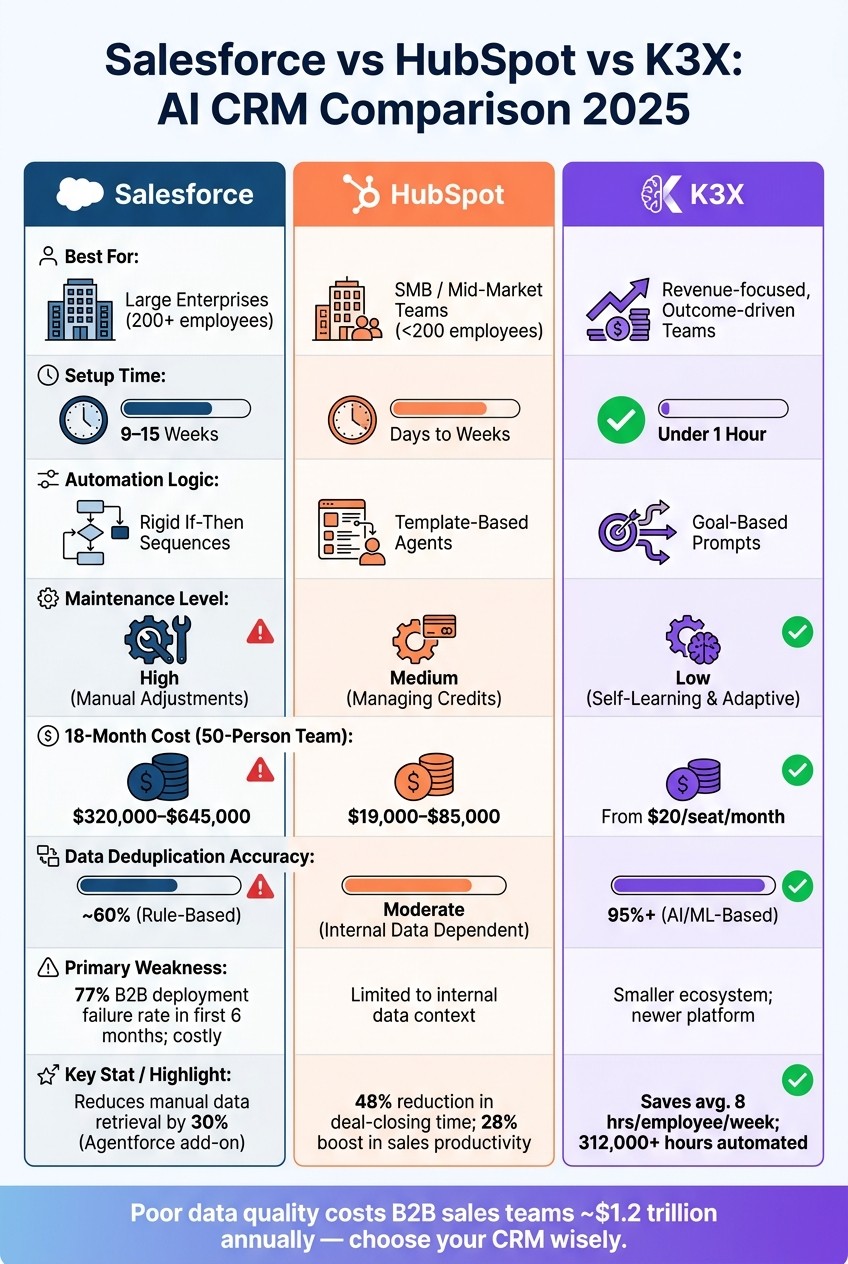
Salesforce vs HubSpot vs K3X: AI CRM Comparison 2025
AI is transforming CRM integration by enhancing operational efficiency and aligning it with desired outcomes. Here's a side-by-side comparison of how three platforms stack up, each with its own strengths and limitations.
Factor | K3X | ||
|---|---|---|---|
Best For | Enterprises (200+ employees) | SMB/mid-market teams (<200) | Revenue-focused, outcome-driven teams |
Setup Time | 9–15 weeks [22] | Days to weeks [22] | Under 1 hour [1] |
Automation Logic | Rigid "if-then" sequences | Template-based agents | Goal-based prompts |
Customization | High (requires Apex/MuleSoft) | Low to medium | High (via natural language) |
Maintenance | High - manual adjustments | Medium - managing credits | Low - self-learning and adaptive |
18-Month Cost (50-person team) | $320,000–$645,000 [22] | $19,000–$85,000 [22] | Usage-based from $20/seat/month [1] |
Primary Weakness | High failure rate; costly implementation | Limited to internal data context | Smaller ecosystem; newer platform |
The table provides a snapshot of critical metrics, but let's delve into the pros and cons of each platform in more detail.
Salesforce Einstein is a heavyweight designed for large enterprises, but its complexity and cost can be overwhelming. With a reported 77% failure rate for B2B deployments within the first six months [22], it’s clear that without a dedicated admin team, many organizations struggle to fully utilize its capabilities. While powerful, it’s often more than what smaller teams need or can manage.
HubSpot Breeze AI is a better fit for growing teams. It strikes a balance between usability and functionality, making it appealing to those without extensive IT resources. For instance, 76% of sales professionals using HubSpot AI report spending more time selling, while 73% see improved win rates [22]. However, its AI operates within the boundaries of internal data, which can limit its broader applicability.
K3X stands out for its speed and cost-effectiveness. With setup taking less than an hour and a flexible, usage-based pricing model starting at $20 per seat per month, it’s ideal for teams focused on rapid execution. Users also save an average of 8 hours per employee each week [1]. While its ecosystem is smaller and it’s a newer platform, its goal-driven logic offers unique flexibility.
"Most systems are linear. They follow fixed steps - and if something unexpected happens, the flow breaks... K3X works on goals. Instead of defining steps like 'Send this email, then wait,' you define the objective." - Mykyta Samusiev, Co-Founder & CEO, K3X [1]
Conclusion
The comparison above makes it clear: every CRM has its strengths, and the right choice depends on your team’s specific needs and priorities.
Salesforce Einstein is tailored for large enterprises with the resources to handle its complexity and cost. Its deep customization options shine in stable, predictable environments, but the trade-off is a longer implementation process and a steep learning curve.
HubSpot Breeze AI works well for growing teams looking for a simpler start. While it’s user-friendly, its reliance on internal data could limit its scalability as your business expands.
K3X, on the other hand, is perfect for fast-moving teams focused on outcomes rather than processes. With the ability to set up operations in under an hour and deliver efficiency gains immediately, it’s designed for teams that want results without needing a dedicated technical team.
"Our sales team was spending half their day on admin work. Now they're talking to customers and closing deals. The ROI was immediate." - Michael Chkechkov, CEO, Ruby Capital Group [1]
The real difference between these CRMs isn’t just about features - it’s about approach. Traditional CRMs often require rigid workflows, while outcome-driven platforms like K3X are built to align with your business goals. By shifting the focus from managing processes to achieving tangible results, these tools free your team to concentrate on what matters most: closing deals. If your team is bogged down with data entry and repetitive tasks, it’s likely time to consider an AI-native CRM to solve the problem.
FAQs
What does “outcome-based” CRM automation mean?
"Outcome-based" CRM automation shifts the focus from rigid workflows to achieving specific business goals. Instead of relying on fixed rules, it uses AI to dynamically adjust actions based on the situation.
For example, platforms like K3X allow users to define objectives with simple prompts. From there, the system takes care of tasks like follow-ups, updating pipelines, and coordinating teams - all in real time. This approach not only cuts down on manual effort but also provides the flexibility to adapt as conditions change, ensuring better results.
How does AI merge duplicates across channels so fast?
AI works quickly to merge duplicate records across various channels by identifying, verifying, and consolidating them in real time. It pinpoints the golden record, resolves any conflicts, and blocks new duplicates from entering the system. This process keeps data accurate, ensures the pipeline runs smoothly, and reduces the need for manual intervention.
How quickly can my team go live with K3X?
Your team can start using K3X right away. It’s built to function seamlessly from the start, eliminating the need for complicated setup. This allows for quick deployment and instant usability, so you can concentrate on reaching your objectives without unnecessary delays or technical challenges.